
All becoming shades
Sonny Rollins, Shonto Begay & Heavy Metal Parking Lot
I remember it like it was yesterday.
I was doing two weeks of active duty at the Navy Reserve Center in Roanoke, Virginia, a place where there are no ports, no oceans, no ships.
In the fleet I was a boatswain mate and I did all the nautical shit you imagine a sailor doing: I stood lookout, steered the ship, chained helicopters to the flight deck during helo ops, for the extra $150 bucks a month of hazardous duty pay. Mostly I swabbed the deck. I swabbed the fuck out of those decks.
But in the mountains of southwest Virginia I spent all my time stenciling “Property of NRC Roanoke” on anything large enough to hold it. Filing cabinets, trash cans, desks.
The center, like all Navy commands, had a quarterdeck at the entrance and we were required to refer to the building as if it were a ship. Walls were bulkheads. Floors were decks. The parking lot was topside. Everything about this was absurd.
It was a hot sticky summer with low rumbling storms that would sail up and down the New River Valley. The sky darkened, the air charged with electricity and ozone, and when the rain came it felt like an explosion.
It was 1992. I’d just graduated from college. I had no plans other than to finish these last two weeks of duty and my enlistment would be over. I’d finally be a civilian again. Then what?
I had no idea.
The navy paid for a cheap motel and a rental car that didn’t have a tape player. The only station I could raise was public radio.
Most of the time I kept the radio off and memorized lines from stories I liked. I had the last three paragraphs of “The Dead” copied out on index cards I kept in my shirt pocket.
One by one they were all becoming shades…
It goes without saying I was incredibly lonely.
After a long day of stenciling, I drove back to my motel to change out of my uniform before going out to get something to eat.
It was dark, a storm was coming, and as I pulled into the parking lot the skies opened. The rain came down like a monsoon in the Philippines.
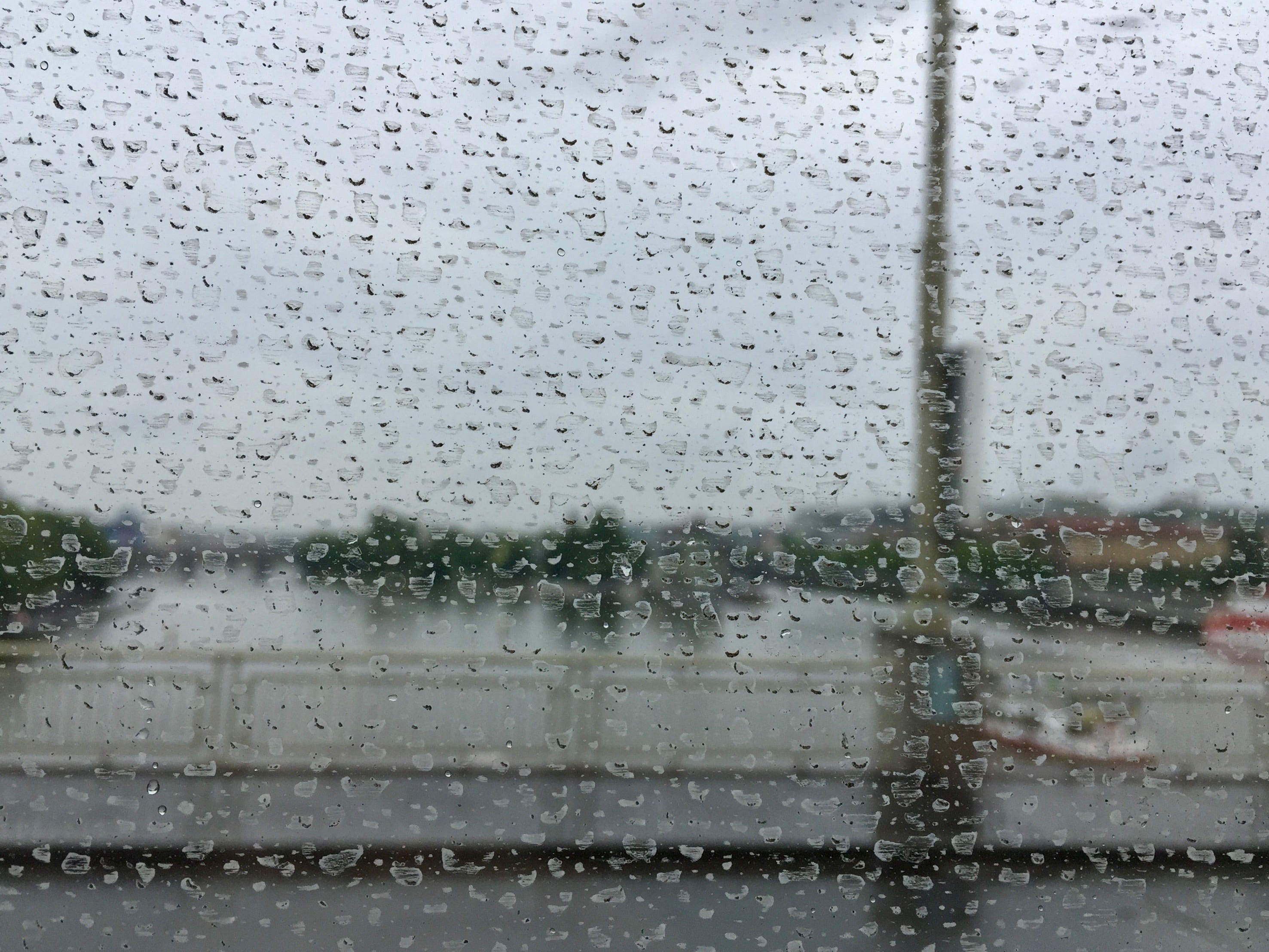
The radio was on, some kind of jazz concert, and as the windows fogged up and the raindrops rattled the windshield, there was nothing to do but wait for the rain to let up. I was hungry for my dinner, some company, my future, but all of that would have to wait.
I leaned back and closed my eyes. The saxophone drifted through the speakers, playing with the patter of the raindrops on the windshield. That horn latched on to my imagination and took it for a ride. Was I high? It felt like it. The music mirrored my emotions, which were all over the place: tentative, forceful, joyous and sad. I didn’t know where this melancholic performance was going, just like my life, but as the clouds parted and the sunlight returned, I stayed in my car. Who was this wizard on the saxophone? I had to know. Not knowing felt like a failure of the education I’d pursued and paid for with blood money from the government.
I sat in the car until the performance ended. Was it raining again? No, that was applause. The announcer said the wizard’s name.
J.D. O’Brien on Shonto Begay
I’m working on final edits to Mightier than the Sword, my novel about four English teachers who go on a crime spree in Northern Arizona, so this profile of Diné painter Shonto Begay by J.D. O'Brien hit my in-box at the perfect time.
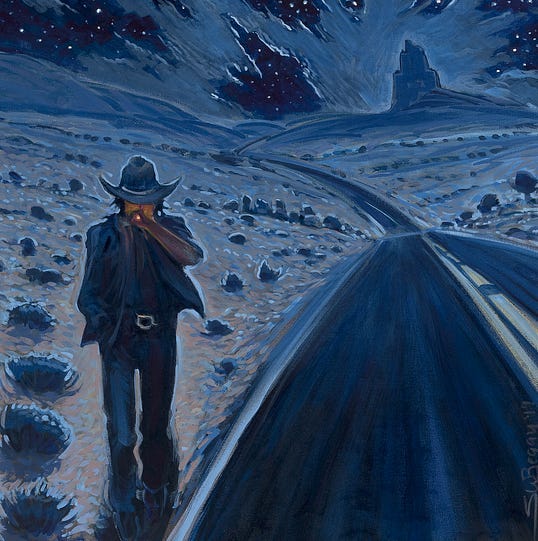
Shonto’s wanderings are all over his work. Look at his paintings long enough and you start to feel like one of his hitchhikers, thumbing toward a dusty horizon under a psychedelic sky. From his two-lane blacktops to his rolling mesas, there’s a sense of endlessness to it all. But like the Tonlea storm patterns on Navajo rugs his mother used to weave, there are built-in escape hatches. On the rugs there is always one line that goes all the way out to the edge. It’s called a “spirit break” because it’s designed to release your spirit from the purgatory of being woven into that one pattern forever. In his paintings, Shonto often leaves a door open for the viewer, a path out of the frame and onto a new plane.
It’s everything you want from a profile of an artist: insight into what makes them tick and a deeper appreciation of their work.
Heavy Metal Parking Lot
Last Sunday was the 40th anniversary of the filming of Heavy Metal Parking Lot. Eric Spitznagel wrote a brilliant essay explaining why it matters.
My generation grew up in a specific American terrarium, warmed by AIDS panic, trickle-down economics, old-school MTV, and the sincere belief that heavy metal was a direct pipeline to Satan, which, if anything, made it better. We lived in mall food courts and wood-paneled basements, under the loose jurisdiction of parents who were either working or disappeared behind a newspaper, with so little adult supervision that it felt less like neglect than a constitutional right.
So we hung out. We hung out in parking lots and behind 7-Elevens and in the woods and in the back seats of friends’ cars while one speaker coughed up Van Halen and the other made a sound like a wasp trapped in a coffee can. Hanging Out was not a “community.” It wasn’t “wellness” or a “third space.” It was what happened when nobody knew where you were and nobody had a way to find out.
Preach, Eric.
In punk rock circles, the video is infamous for a quote by a wastoid in a sleeveless zebra-striped T-shirt: “Heavy metal rules! All that punk shit sucks!”
I always thought that guy looked like he’d fit right in with the burnouts at my high school and now I know why. Somehow I didn’t realize that the doc was filmed in 1986, the year I graduated from high school, and the parking lot in question is at the Capital Center in Landover, Maryland.
I’d seen Rush, Dio, and Van Halen at the Capital Center, which means I’d been to this parking lot. Made many bad decisions in this parking lot. Puked on my shoes in this parking lot.
I sent it to my brother who sent it to his friends and lo and behold one of them texted back: I’m in that movie. He doesn’t have a speaking part, but he’s in it all right. My brother forwarded the screen shot of his friend Brady wearing a white polo with the collar popped and Vuarnet sunglasses. He looked like the bad boyfriend of the love interest in a John Crier comedy.
When I was in high school, my best friend Steve had a van and a video camera and we made many, many movies. But the idea of anyone watching them would have been mortifying. We didn’t make them to share them with the world. They were for us. That’s the difference between my generation and all that came after.
Thanks for reading! If you liked this newsletter you might also like my latest novel Make It Stop, or the paperback edition of Corporate Rock Sucks: The Rise & Fall of SST Records, or my book with Bad Religion, or my book with Keith Morris. Message from the Underworld comes out every Wednesday and is always available for free, but paid subscribers also get my deepest gratitude and Orca Alert! on most Sundays. It’s a weekly round-up of links about art, culture, crime, and killer whales. Since you’ve read this far, you might as well go ahead and pre-order my new novel now…
Thanks for this! 20-year Army here (combo of active/deployed and reserve), graduated HS in '89 from Hagerstown MD. Also, love boxing gyms. All this doesn't make us cousins or anything, but it's nice to know you are out there. Love the writing.
Not sure if you've ever done this, but it might make sense to write a piece on the punk-jazz connection. It's pretty deep, going back all the way to the Stooges at least and cutting through to SST groups like Saccharine Trust, GONE and of course the Minutemen and Byron Coley's obsession with Free Jazz, etc. Plus I used to have a punk rock gf who could geek out with the best of them as far as jazz went. That was never me, but I'd certainly read somebody who could connect those dots.